Monday, March 30, 2015

Ranking the Movies of Madeline Kahn, Part I


Madeline with Gus in Won Ton Ton. The dog’s approach to acting led Madeline to reflect on her own methods. (But you’ll have to read the book to find out what she said.)

Writing Madeline Kahn’s biography has given me the opportunity to revisit many films I love — and the obligation to watch other films I missed the first time around. The classics hold up well, and few actors will ever rival the swift succession of brilliant projects that launched Madeline’s career: What’s Up, Doc?, Paper Moon, Blazing Saddles, and Young Frankenstein. Along with Clue, those movies are the foundation on which Madeline’s reputation rests, and chances are, you’ve seen them already, or you wouldn’t be here now.

As I combed through Madeline’s legacy, I made a few sparkling discoveries, too: buried treasure, if you will. But not every one of Madeline’s movies, and not every one of her performances, delivers the promised pleasures. Some of her films I can’t recommend except to her most hardcore fans, and others don’t do much to help our understanding of what made Madeline such a memorable performer. While it’s important to note that I watched at home, without an audience of strangers to share the experience with me, a remarkable number of the comedies in which Madeline stars are entirely lacking in laughs — and you’ve got to be a completist to want to see them.

As we approach the release date of Madeline Kahn: Being the Music • A Life, I’d like to provide a guide — subjective, opinionated, and open to debate — on Madeline’s screen oeuvre, and I’ll start with the pictures that, really, you can afford to skip.

THE MISSABLE: I WATCHED SO YOU DON’T HAVE TO


Madeline’s mother, Paula Kahn, worked as an extra in Won Ton Ton. She’s seen here, between and behind Teri Garr and Billy Barty.

Won Ton Ton, the Dog Who Saved Hollywood. What ought to have been a non-musical Singin’ in the Rain, an affectionate, knowing satire of Hollywood in the days of silent movies, turns out to be a stupefying mess, largely due to the directorial ineptitude of Michael Winner (best known for directing Charles Bronson in Death Wish). A cavalcade of old-time stars and the justly beloved Teri Garr are wasted here; co-star Ron Leibman (spoofing Valentino) is downright offensive. Even children who might enjoy a doggie picture are advised to steer clear of Won Ton Ton, whose canine lead spends a portion of the movie trying to commit suicide in several ways that kids really, really shouldn’t try at home. Madeline’s performance earned praise from reviewers (the New York Times compared her favorably with Chaplin, Keaton, and Fields), but seen today she seems at once shrill and tentative. It’s a rare leading role for Madeline onscreen, but it’s no fun to watch.


With Grant (far left) and Robert Viharo (in red headband) in Gemini.

Happy Birthday, Gemini. One might develop a theory that, the less confident Madeline was onscreen, the higher she pitched her voice. Albert Innaurato’s hit play Gemini here suffers from a couple of performances aimed not at the camera but at the back row of a very large Broadway theater, and Madeline’s attention-hogging character helps to unbalance the movie as a whole: the central plot, about a Harvard student who’s falling for his girlfriend’s brother, gets lost. Interesting mainly for glimpses of the off-camera relationship between Madeline and David Marshall Grant (as the brother) and as a relic of the earliest days of gay cinema, directed by Richard Benner, whose Outrageous! blazed trails in the genre.


With Dudley Moore in Wholly Moses!

Wholly Moses!. Released after another Biblical spoof, Monty Python’s Life of Brian, this movie suffered by comparison, but even on its own terms, it’s a mess. Vulgar sexual humor mixes with occasional references to Scripture in a screenplay that seems to be scotch-taped together by a chimpanzee in the editing room. Madeline appears very briefly as a purveyor of aphrodisiacs, offering a couple minutes of exposition and not much else.


With Lewis and Feldman on the set of Slapstick.

Slapstick (Of Another Kind). Director Steven Paul cheerfully accepts responsibility for the failure of this movie, which really is as bad as you’ve heard. While Paul deserves credit for directing, producing, and co-writing a movie (only his second feature film) on a small budget with big-name stars, he never finds a way to approach the material — a sorta sci-fi story about grotesque twins who are geniuses when they’re together and idiots when they’re apart. Somehow, with Jerry Lewis and Marty Feldman on hand, even the slapstick routines are utterly laugh-free.


Reunited, again: with Klein in Mixed Nuts.

Mixed Nuts. Nora Ephron’s comedy — an Americanization of the French farce Le Père Noël est une ordure (Father Christmas is a shit) — does find its defenders, especially among fans of Adam Sandler, and maybe it seemed funnier in a theater than it did on video at my house. But really, what plays in Paris is cast adrift in Southern California, and the movie is tonally off, start to finish. Mixed Nuts is redeemed primarily by Liev Schreiber’s wholly committed performance as a suicidal transvestite, and by the teamwork of Madeline and Robert Klein, her most frequent co-star and close friend, just after their award-winning Broadway run in Wendy Wasserstein’s The Sisters Rosensweig.

LOOK FAST! THERE’S MADELINE!


Close to home, in many ways: Madeline lived near the Metropolitan Museum of Art, making an easy commute for filming her single scene in Mixed-up Files.

From the Mixed-up Files of Mrs. Basil E. Frankweiler. This adaptation of E.L. Konigsburg’s Newbury Award-winning novel is pretty bad, actually, and even as a kid I squirmed at the amateurish performances of the child leads around whom the entire movie revolves. But for about three minutes, Madeline commands the screen, playing a schoolteacher on a field trip who’s so harried that she doesn’t realize that two of the kids in her group aren’t really her students. Madeline had taught school and wears precisely the sort of outfit she’d have worn in real life: she seldom got the chance to play a character so much like herself. Best advice: watch the clip of Madeline’s scene on YouTube, skip the rest of the movie, and re-read the book.


Just a Myth: With Kermit.

The Muppet Movie. Even if you didn’t grow up on this picture, it holds up beautifully, as the beloved characters follow the winding road to the Emerald City of Hollywood. Two of Madeline’s favorite actors, Charles Durning (who played her father in Boom Boom Room) and Austin Pendleton, play the Muppets’ antagonists, and several other friends are on hand — but Madeline shares the screen only with her pal Carol Kane, Telly Savalas, and a certain frog. It’s a fun scene, but, Madeline’s mother possibly excepted, nobody bought a ticket just to see her in this movie.


As Martha Mitchell.

Oliver Stone’s Nixon. Madeline’s last onscreen appearance in a studio feature is a cameo role, in just two scenes as Martha Mitchell, the wife of U.S. attorney general John Mitchell (played by E.G. Marshall, who was older than her father). Reviving the Southern accent of Miss Trixie Delight, Madeline provides something like comic relief, though one realizes later that nothing she says is funny. It’s deft, surgical work, showing Madeline at the peak of her powers; instantly she creates a fully rounded character who knows precisely how to wound her husband and Nixon himself.

Coming Soon: Not-Great Movies That Aren’t a Complete Waste of Time.

Saturday, December 13, 2014

Meatballs à la Madeline Kahn


Madeline knew her way around the kitchen.

If you’re a Madeline Kahn fan and you’re looking for the perfect hors d’œuvre for your next cocktail party, here’s your solution. Thanks to Betty Aberlin, I’m able to share with you Madeline’s own recipe for sweet and sour meatballs, as reported in the Chicago Tribune in 1975.

A few provisos: I haven’t tested this recipe, you’d better have no moral objections to veal, rolling the meatballs can get your hands messy (Madeline herself offered this warning), and some of the ingredients are processed. For example, you might prefer to mince and sauté a fresh onion, instead of taking “instant minced onions,” soaking them, and then sautéing them. Johna Blinn, the reporter on this story, noted that, at the time, Madeline was “learning how to live a healthier, happier life by studying homeopathic medicine, herbs and organic foods!” (Exclamation point in the original.) So as you follow the recipe, just consider that this may be what passed for organic in 1975.

Like the recipe itself, the Tribune article is a product of its time, taking a tone that’s simultaneously admiring and condescending as Johna Blinn notes that Madeline “is an operatic singer, speech therapist and a voracious reader” — and she can cook, too! Gee, fellas, this one’s a keeper!


Fifteen meatballs is my limit.

Madeline was still living on East 73rd Street at the time, and she complained of her tiny kitchen, which prevented her from throwing real dinner parties: “I don’t like doing things halfway, so I really don’t try and cook whole meals very often. I’m more apt to invite someone in for cocktails, and that’s when I bring on the meatballs!” Shortly after the article appeared, Madeline moved to her Park Avenue apartment, where the kitchen was (from what I can tell from photos) spacious by Manhattan standards — or anyway, I’d gladly trade with her.

Madeline’s description of her approach to cooking chimes with her approach to acting. “When I cook, I just improvise as I go along,” she said. “It’s never quite the same from one time to the next.” In the movies, this improvisational approach to acting led to “Flames! Flames on the side of my face!” and gave directors a variety of takes to choose from. In theater, her approach yielded admiration from some colleagues (Kevin Kline, for example), frustration from others (Victor Garber — affectionate frustration, I hasten to add), and fury from others (notably Hal Prince).

Madeline’s meatball recipe is the result of sampling other recipes and experimenting with her own — and since that’s the way I cook, I’m in no position to say she’s wrong.


An improvisational approach.

MADELINE KAHN’S SWEET AND SOUR MEATBALLS

FOR THE SAUCE:
1 cup tomato sauce
2 tablespoons lemon juice
2 tablespoons dark brown sugar
1 tablespoon instant minced onion
1 tablespoon salad oil
1 tablespoon powdered mustard
1 teaspoon salt
½ teaspoon garlic powder
¼ teaspoon ground red pepper
1 cube chicken or beef bouillon
Combine all ingredients. Bring to boil, stirring constantly. Set aside. Makes about 1¼ cups.

FOR THE MEATBALLS:
2 tablespoons instant minced onion
2 tablespoons water
1½ tablespoons butter
1 cup soft bread crumbs
1 cup light cream
1½ pounds lean ground beef
½ pound lean ground veal
1 egg, beaten
1½ teaspoons salt
1/8 teaspoon ground white pepper
1/8 teaspoon ground nutmeg
1/8 teaspoon ground cinnamon or curry
Rehydrate onion in water; let stand 10 minutes. In large skillet, melt butter; sauté onion 5 minutes. Soak bread crumbs in cream. In large mixing bowl combine onion, bread crumb mixture, meats, egg, salt, pepper, nutmeg and cinnamon or curry. Mix well, but do not overmix. Shape into 1½-inch meat balls. Let meatballs stand in refrigerator 30 minutes before cooking. Line baking sheet or broiler tray with aluminum foil. Broil meatballs in preheated broiler until lightly browned. Turn to brown on other side. Watch carefully so meatballs do not overcook. Serve meatballs in heated sauce. Makes about 3 dozen.


Monkey’s brains, though popular in Cantonese cuisine, are not recommended for this recipe.

Wednesday, July 31, 2013

Eileen Brennan


She really did love music.

“Music means more to me than anything,” Eileen Brennan said to me. “Even more than dogs! Even more than cats!” It’s one of the best things anybody ever said to me in an interview.

I spoke with Brennan by phone the day before Thanksgiving, 2009. She was distracted by the old movie playing on TV in the background, and her memory wasn’t as sharp as it used to be. She apologized for the latter, but not for the former. “Why don’t you write about dementia?” she wanted to know. “And tell people to get ready for it!”


She’d survived a horrific traffic accident, though she said she didn’t know whether her memory trouble had anything to do with the head injuries she sustained then. She’d also survived breast cancer and an addiction to painkillers; she was a recovering alcoholic, too, perhaps not unlike the woman she played so memorably on thirtysomething, Elliot’s mother.

But the key word here is “survivor,” and what I took away from our conversation was that Eileen Brennan was — and I say this with the greatest possible admiration and affection — one tough, thoroughly adorable, pretty damn crazy old cat lady. “Life is hard, that’s all I have to say to that,” she said to me, and she lived 80 years of incident and enthusiasm.


In The Sting.

Her first inspiration was Jane Powell, she said, and she did perform in musical comedies, including Little Mary Sunshine and the original cast of Hello, Dolly! But I missed those; I know her work in movies and on television, where I feel as if I got a fair sense of her as a person.

Looking back, I’m struck by the infinite variations she brought to her own brand of world-weariness. Even before the picture started, you could tell that an Eileen Brennan character already had seen it all. Sometimes experience made her impatient, as in Private Benjamin or Will & Grace; sometimes she accepted her lot, as in The Last Picture Show or Murder by Death. But she kept going — most often with her sense of humor intact.


In The Last Picture Show.

I got a taste of her real-life impatience when we talked a bit about Off the Rack, a short-lived sitcom she did with Edward Asner. I’ve still never seen it, but Brennan had just run into the actress who played her daughter on the show, and so it was much on her mind. “We got brilliant reviews,” she told me, and yet the show was cancelled after six episodes. The younger actress had said to Brennan, “I don’t know what happened.”


Just a couple of middle-aged people?
Asner and Brennan in Off the Rack.

“Maybe [the network] didn’t want two middle-aged people,” Brennan mused. “And fuck them! We were so happy together. I ran into one of those assholes [the network programming executives] in the supermarket and said, ‘You did the wrong thing, and you were wrong.’”

She said she still missed Asner and Dennis Haysbert, another co-star in Off the Rack: “I cried when the show broke up.” At the time of our conversation, I had recently interviewed Asner, Madeline Kahn’s co-star in Born Yesterday on Broadway, and so, with Brennan’s endorsement, I called his office and passed along Brennan’s phone number. I hope they spoke again — at least a few times.


In Murder by Death.

“I love actors to death,” she told me. “They really mean a lot to me, because they work so hard, and they have to put up sometimes with such shit. I really feel sorry for actors, but I love them. Carol Kane called the other day and said she was offered a thing and said, ‘No, that’s not for me. Call Eileen Brennan.’ You’ve got to remember when you’re working with other actors, don’t put ’em down — because other actors get you work.”


As Mrs. Peacock in Clue.

Brennan and Madeline Kahn met and became friends during the filming of At Long Last Love, when they would commiserate late into the evening about the long rehearsals and the endless takes and retakes, in which all the actors sing live on-camera. At some points, they were getting together on an almost nightly basis, and though their friendship ebbed and flowed over the years, Brennan recalled Madeline with lasting affection.

“If Madeline were here — ” she started to say, then gave an audible shrug. “She missed all this shit that you go through when you get old. I salute her. It’s not easy, not easy at all.”


In Will & Grace.

I’m not overstepping the limits of biography when I suggest that, if Madeline were here, she’d be grieving today for her co-star and friend. And personally, I know that, as an audience, I’m grieving for an actor who brought such life and such wit to her work — and who did so much to teach me the challenges but also the virtue of indomitability. Only death could keep Eileen Brennan down.


And as long as we’re watching her movies —
she may be down, but she’ll never be out.


Wednesday, August 8, 2012

Madeline Kahn: Progress Report 15: Santa Fe Trails

The Armory for the Arts, as it appears today.
Photo by WVM.


Madeline Kahn’s connection to Santa Fe, New Mexico, represents an important chapter in her biography, though it constituted discrete episodes in her life. In the 1980s, she worked with the Santa Fe Festival Theater; in the 1990s, she acted in a European TV adaptation of René Goscinny and Morris’ immortal cowboy comic books, Lucky Luke, and visited her aunt, Virginia Lewisohn Kahn, who lived in the area.

Because the Festival Theater folded in 1985, there’s virtually nothing about it on the Internet, and most of what I knew before last week came from interviews with one of Madeline’s Santa Fe co-stars, Victor Garber; and with the man who directed her in two productions there, a musical adaptation of Franz Kafka’s Amerika and Noël Coward’s Blithe Spirit, Robert Allan Ackerman.

Clearly, I needed to visit Santa Fe for myself and to search for traces of Madeline’s time there. Susan Graham’s concert with Santa Fe Opera provided an ideal target date for my trip, and so last week, when I wasn’t listening to music and hobnobbing with the gratin of Opera World, I was poking around the Santa Fe Public Library, the New Mexico State Library and Archive, and the theater where Madeline worked, the Armory for the Arts.

Blithe Spirit: Amy Irving, costume designer Perry Ellis,
and Miss Madeline Kahn.
WVM photo of an uncredited photo in the New Mexican’s
Pasatiempo section, Sept. 19, 1986.

Among the first and most important lessons I learned was the confirmation of the correct name of the theater group: not the Santa Fe Theater Festival, but the Santa Fe Festival Theater. These distinctions can be meaningful, but in this case it’s somewhat fine. From an interview with artistic advisory board member Angela Lansbury, on the front page of the New Mexican on June 17, 1981, the Festival Theater’s reasoning was explicit: if Santa Fe could sustain an opera festival, it could sustain professional theater, as well.

Speaking with the local newspaper just prior to the first opening night (The Front Page, on June 29, 1981), Lansbury, producing director Thomas Gardner, and executive director Christopher Beach promised a mix of young professionals and seasoned veterans in repertory that allowed them to branch out in new directions. (The first season’s other offerings were Cyrano de Bergerac, starring Michael York, and Ted Tally’s Terra Nova.)

With matching funds from the New Mexico legislature, the Festival Theater renovated the National Guard Armory, a WPA project, completed in 1940, that stands on Old Pecos Trail. Today, the theater occupies roughly half the building, while the other half is devoted to a museum honoring the state’s servicemen and –women. A disproportionate number of New Mexicans having been forced on the Bataan March, the museum is named the Bataan Memorial, and the collection, covering a number of military conflicts, is judiciously chosen, tastefully exhibited, and always thought-provoking.

The creator of Lucky Luke, René Goscinny at work.

The theater itself seems tiny when one considers the outsize ambitions of the Festival’s founders: just 340 seats, it hardly seems the venue for such all-star productions as Blithe Spirit, which starred Madeline, Victor Garber, and Amy Irving; or The Glass Menagerie, in which Irving starred as Laura opposite her real-life mother, Priscilla Pointer.

With hindsight, some of the repertory choices seemed to spell the Festival’s doom. The second season, for example, featured not one but two world premieres, Amerika, with a book by Israeli playwright Yoram Porat and music by Shlomo Gronich; John O’Keeffe’s Western spoof, Wild Oats, preceded it. It’s tough even for an established theater to generate audiences for new work; for a fledgling troupe, the challenge must have been even greater.

Even some of the casting choices seem puzzling in retrospect. It’s easy to justify Madeline’s casting in Amerika: she played three roles, which must have helped to stimulate interest in the new work. Blithe Spirit is a more curious case: Irving played the disruptive ghost, Elvira, a part in which she surely excelled and yet one that would seem tailor-made for Madeline instead. For her part, Madeline played the loopy medium, Madame Arcati, a role indelibly associated with Margaret Rutherford and Beatrice Lillie, and one for which just about everyone (including Garber and Ackerman) agrees Madeline would be ideal today — nearly 30 years after the show closed. But the mission of the Festival Theater was to give established stars a chance to do something different, and so audiences saw a too-young Arcati.

Italian actor Terence Hill, veteran of spaghetti Westerns,
with an unidentified colleague as Lucky Luke’s horse,
Jolly Jumper.


Learning more about Lucky Luke may be challenging. During my sojourn in France, Goscinny’s daughter, Anne, moved to capitalize on her late father’s legacy, as well as the mammoth success of a live-action movie adaptation of Goscinny’s best-known work, Astérix. We got sequels to Astérix, a live-action adaptation of Iznogoud and a tidal wave of Le petit Nicolas: two books full of previously unpublished short stories, a live-action movie, and an animated TV series, to say nothing of greeting cards and school supplies.

An animated series of Lucky Luke has been a staple of French TV (and in-flight entertainment on airplanes!) for years; during the glut of Goscinny movies, we got a new animated feature film, starring the voice of Lambert Wilson as the voice of the eponymous hero
, a laconic cowboy gunslinger who draws faster than his own shadow. And in a live-action feature, Jean Dujardin, Oscar-winning star of The Artist, took the role. The 1990s live-action TV series, largely a German effort, may have represented the kind of competition that the copyright holders preferred to squelch: in any case, the principal trace I’ve seen of the show is a couple of Polaroids showing Madeline in her costume as Esmeralda, a Gypsy. [UPDATE: All the Lucky Luke episodes are available for streaming on Amazon; Madeline’s episode is pretty good, and it features some delightful teamwork with Julie Hagerty.]

There’s a great deal more I hope to learn about Madeline’s time in Santa Fe: if you or anyone you know can enlighten me in any way, I hope you’ll get in touch with me.

Dujardin’s Lucky Luke was infinitely more faithful than Hill’s to the original design by Morris, one of the greatest artists of bandes-dessinées.

NOTE: Having grown up in Argentina and lived as an adult in New York City, René Goscinny possessed boundless appreciation for non-French culture (including American cowboy movies), and it informed his writing. It is a truth universally acknowledged in France that, had Goscinny not died prematurely, he would have been the first comic-book author to be inducted into the Académie Française. But die he did, and none of his predecessors has received that honor.


Wednesday, June 13, 2012

Madeline Kahn: Progress Report 14: When Hiller Met Paula

Paula Kahn, Dramatic Soprano.
A head shot, probably from the early 1960s.
In later years on her acting résumé, she listed her “special skills”:
“Belly-dancing, Mother of a Star.”
Photo courtesy of Jeffrey Kahn.


In 1948, Hiller Kahn’s girlfriend suggested that they drop by the apartment of an attractive divorcée who worked under her. Freda Goldberg Wolfson’s daughter had earned a certain renown already for her singing ability, the girlfriend said, and when they got to the apartment, on West 60th Street just off Columbus Circle, there was tiny Madeline Gail Wolfson, standing on a table for her stage and performing popular standards for about a dozen friends and neighbors, while her mother played piano. Madeline was about six years old, and had come home from the Pennsylvania boarding school where Freda had enrolled her one year before.

Little Madeline was “endearing,” Hiller remembered in conversation with me, long afterward, though Freda didn’t impress him much at first. Soon enough, however, he found himself caught up in her formidable charms (which I witnessed firsthand a few years ago). In 1953 in Mexico, he married her, and at his insistence, he adopted Madeline and brought her to live with them in Jackson Heights. “I wanted her to be part of the family,” he told me simply. Madeline kept his name the rest of her too-short life.

Freda and Hiller divorced in 1958. He passed away on June 6; five days later, she died after several years of declining health. My condolences to their son, Madeline’s brother, Jeffrey, and every member of their families are heartfelt, mingled with shock at the terrible coincidence and with gratitude that Jef consented to share them with me.

I’m struck by how many of the family dynamics came into play already at that first meeting in New York. Hiller and Freda really weren’t meant to be together, as it turned out. Freda, who eventually adopted the more marquee-ready name of Paula Kahn, had studied opera and was Madeline’s first voice teacher; she harbored dreams of success on stage or screen, but it was her daughter who became the star attraction: starting perhaps with Hiller, good things often came to Paula because Madeline made them happen.

But the relationships are remarkably complex. Paula trained Madeline in the talents she needed to succeed, and the same talents might have paid off for Paula, too, if only she’d been willing to work as hard as her daughter did. Instead, she seemed to expect stardom to be handed to her, and if her glorious and inevitable destiny was to be fulfilled at the expense of Madeline’s finances and reputation, so be it.

A thoroughly decent guy, Hiller tried diligently to bridge the gap between him and Madeline, especially in later years, but much of the damage was done already. All of her childhood taught the lessons of abandonment, which surely marked her as an adult. Both her father and stepfather left in the aftermath of divorce; Paula left her at boarding school. Even Jef, always Madeline’s indispensable emotional support, would go off to visit Hiller, leaving her alone with Paula.

Madeline’s romantic relationships were affected as a result, naturally, and she wasn’t consistently able to prevent her insecurities from coloring her professional relationships, too. If her personal experiences made it easier to play fragile or neurotic characters so memorably onstage and onscreen, they sometimes made her a difficult collaborator offstage and offscreen.

Treating Madeline and her parents fairly may be the greatest challenge before me as I write her biography. Misjudgments and misbehaviors by a parent can result in such painful consequences for a child, and yet there was plenty of good, too, and Madeline would not have been the person or the artist she was without their influences. The same is true of any parent–child relationship, of course, and few of us ever manage to reconcile ourselves to that. Until somebody comes up with a better system, there’s nothing left but to study and to try to understand.

Tuesday, May 15, 2012

Madeline Kahn: Progress Report 13: Standing Up for Madeline

Robert Klein

Last night I attended the annual “Evening of Laughter,” a benefit for the Ovarian Cancer Research Fund in honor of Madeline Kahn. Presented each year at Caroline’s Comedy Club in Times Square, the evening entails an auction — goods and services that range from the irresistible to the inexplicable — and a series of turns by stand-up comics. While Madeline herself wasn’t a stand-up and was remarkably uncomfortable in certain kinds of improvisational comedy,* she had a number of truly gifted friends in the field, and two of them typically rise to the occasion: Joy Behar and Robert Klein.

Klein is a noteworthy case, since he and Madeline appeared together in Leonard Sillman’s New Faces of 1968 (Madeline’s Broadway debut), dated briefly, and continued to work together for 30 years, through The Sisters Rosensweig, Mixed Nuts, and Cosby, right up to the end of Madeline’s career.

Behar and Madeline knew each other socially, becoming good friends over time, and most years it’s Joy who acts as master of ceremonies for the stand-up benefit. Last night, however, she had to back out, and now that I’ve seen the interview she conducted earlier in the day yesterday, I understand completely: even an experienced hand like Dan Rather gets tired after interviewing the President of the United States, and the women of The View ran a marathon with Barack Obama yesterday.**

Joy Behar

Because of the participation of these headliners and of Caroline Hirsch, the impresario of the eponymous comedy club,*** the “Evening of Laughter” benefits draw a pretty stellar lineup each year. Last night was no exception, and with Susie Essman taking over as MC, we enjoyed the company of Klein, Judy Gold, Colin Quinn, Kevin Meany, as well as two comics new to me, young Mark Norman and Drew Fraser; the charming (and francophile) Jenna Wolfe helped out during the auction.

Klein’s monologues are less routines than extended philosophical musings: if Socrates were Jewish, straight, and living today, he might well sound like Robert Klein. I’ve always admired his work, and it’s a treat to see him up close. While some other aspects of stand-up mystify this audience, and not only individual jokes but entire veins of humor seem directed at somebody other than me, I’m most impressed on these occasions with the generosity of the comics, the sincerity of their admiration for Madeline and of their desire to help to fight a terrible disease.

Our mistress of ceremonies, Susie Essman

Moreover, they unite to fight with laughter, and this is something I believe Madeline would approve. She understood — as well as anyone ever has — that laughter is a tool that has changed minds and lifted spirits. So it’s not surprising that the idea for the benefit originated with someone who understood Madeline: namely, John Hansbury, her boyfriend, whom she married shortly before her death.

In the way that caring for an ailing loved one makes any of us expert in a disease, so John became an expert in ovarian cancer; today he is co-president of the OCRF executive committee, and the stand-up benefits have brought in more than $1 million in 11 years. John will tell you (as he has told me, chapter and verse) of the need for effective early detection of ovarian cancer, and of the OCRF’s mission: testing, treatment, and some day, a cure. These were the goals Madeline herself endorsed, when she made her own illness public.

So much of Madeline’s legacy is the work she did herself — as we were reminded in the clips from her Oscar-nominated turn in Paper Moon that began last night’s show. But no legacy stands on its own entirely: it must be picked up by the rest of us and carried forward. That’s why I’m writing this book. That’s why John has linked Madeline’s name to the OCRF. And it’s why I’ll continue to contribute to the OCRF. I hope you’ll consider doing so, too.

Miss Trixie Delight


*NOTE: To corroborate my assertion, I point to Madeline’s ad-libbed conversation with Barry Humphries, making his first U.S. television appearance in the person of his celebrated character, Dame Edna Everage, during an episode of Saturday Night Live. Madeline’s discomfort is palpable, and I refuse to believe that’s merely because she was talking to a man in a dress. She liked a good script.

**It was suggested that Joy Behar may have injured herself yesterday, in addition to the workout she got while prepping for the interview. I guess we’ll know soon enough whether she emerged unscathed.

***John Hansbury tells me that Caroline Hirsch got to know Madeline when she hosted another fundraiser at the comedy club.


Monday, April 23, 2012

Madeline Kahn: Progress Report 12

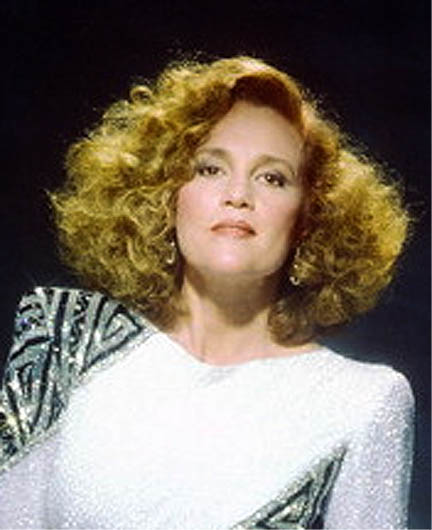
Though this isn’t the best copy of the image,
I’m quite smitten with this portrait of Madeline:
beautiful, proud, and in the spotlight,
where she belongs.


It’s my immense pleasure to announce that the University Press of Mississippi has contracted with me to publish the authorized biography of Madeline Kahn. For now, no publication date has been set, since I have to resume my research and interviews, and at some point actually write the thing — but I am very much and very joyfully back in business.

To the best of my ability, I’ll use this space to keep readers up to date. For now, I can tell you that my working title for the book seems to have passed muster, and it may yet wind up as the real, final, and official title: Taffeta, Darling! The Life and Work of Madeline Kahn.

Taking my cue, of course, from the farewell scene at the train station from Young Frankenstein.

In a troubled economy, the process of finding a publisher has been longer by far than anticipated, and sometimes brutally discouraging. In fact the Press first confirmed its interest in the book just hours after my seemingly ominous encounter with a homeless author on the New York subway — that is to say, when all looked most dire.

Now I feel we’re in very good hands: the Press does a terrific job with books like mine, and I’ll be working with a first-rate editor. Really, I’m not sure things could have turned out more happily.

To all those who have helped me so far, thanks — and keep it coming! I’ll need plenty more help before this thing is done. And to one and all, please, do leave comments here, and do keep coming back for updates.

Foxy lady: That fur piece didn’t survive its encounter with Marty Feldman.