Thursday, March 17, 2011

Madeline Kahn: Progress Report 11: L’Homme du Train

Approaching.
Photographs taken with my phone, believe it or not.


I was homeward bound on the subway the other night, after a glorious performance by Janice Hall at the Metropolitan Room, dinner with good friends old and new, and the uncanny experience of watching the composer Jorge Martín fall into a trance state while watching “America” from West Side Story at Musical Mondays at Splash, a bar in Chelsea.

The track is a long one, and I passed the time by reading. As we neared my station, I pocketed the book. “Why’d you do that?” asked the drunken, disheveled old man across from me.

“I’m getting off at the next stop,” I replied.

“I’m writing a book,” the old man went on, and my heart began to sink.

“You live on the streets long enough, you get enough stories for a book,” he went on. “You meet so many people, so many things happen. You just gotta write a book.”

Standing.

He didn’t ask for money, and at the end of the long evening I didn’t really have much to spare. I wished him luck as I stepped out of the car and hurried back to my apartment.

When did the MTA install mirrors in subway cars, I wondered, and since when are they futurized? Because it seemed as if I’d just seen my own reflection, a few years from now, a few more stops down the subway line of life.

How often do I go around saying, “I’m writing a book”? Is the assertion any more realistic than the old man’s? Especially since I’d put the Madeline Kahn biography on indefinite hold, pending an offer from a publisher that never came.

Why wouldn’t this man possess the gift of prophecy? As he himself said, he’d met so many people, seen so many things. Why wouldn’t he know?

And yet, almost from the instant we met, my fortunes began to change. Perhaps he’s not a prophet but a sort of pascal lamb, who’s taken on the bad luck that used to be or might have been mine. Who knows?

Whatever the case, I have received portents and affirmations; now there is no more doubt. I am indeed writing a book, I am indeed the authorized biographer of Madeline Kahn — and I’ll be posting a major announcement here, very soon. Look for it.

Departing.


NOTE: The title of this essay is derived from that of Patrice Leconte’s charming film, co-starring Jean Rochefort and Johnny Hallyday (2002).


Wednesday, February 16, 2011

Madeline Kahn: Progress Report 10

As Franz Liebkind

I first saw Kenneth Mars, the actor who died on February 12, on Fernwood 2-Night, the syndicated comedy series that grew out of Mary Hartman, Mary Hartman and seemed so grown-up, even illicit, because it aired late at night, past my bedtime.* Mars played local businessman W.D. “Bud” Prize, a recurring character, and exhibited many of the qualities that marked his more famous performances, notably an exaggerated accent and an inspired range of belligerent arrogance and barely controlled lunacy.

His chin always seemed ready to pick a fight, and he led with it, much the way a rooster in a barnyard leads with its beak; in later years, I came to think he’d be an excellent choice to play Richard Wagner. (Bud is self-conscious, however, and frequently wears a “chin-odontic device” to change its alignment.) In two important screen roles, Mars’ chin is practically a star player, surveying a dining room of lesser mortals in Peter Bogdanovich’s What’s Up, Doc? and rallying a mob in Young Frankenstein. But that chin could be vulnerable, too, even while making me laugh, as Mars proved in The Producers.

After all, any writer frustrated in his ambitions must feel a little sympathy for the playwright Franz Liebkind.

With Zero Mostel and Gene Wilder in The Producers

Mars’ death is itself a disappointment to this writer. I’d like to have met the man who made me laugh so hard; beyond that, I’d like to have interviewed him for my authorized biography of Madeline Kahn. They appeared together in What’s Up, Doc? and Young Frankenstein, milestones in each career, and both starred in the ill-fated pirate farce Yellowbeard, as well. What stories Kenneth Mars might have had to tell me!

What’s Up, Doc? was Madeline’s first feature film, and her first indication that she might not always get to play the “pretty girl.” As I’ve explained here, she was miserable during the production; while she and Mars share the screen only briefly, he might have been able to shed more light on her state of mind and the process whereby she overcame her unhappiness to deliver an explosive, star-making performance.

As Hugh Simon: Pissing from a great height.
Mars towered over his What’s Up, Doc? cast mates.


Young Frankenstein, by contrast, was one of Madeline’s happiest moviemaking experiences. She and Mars have no scenes together, except for the triumphal march by the entire cast that was filmed on the last day of shooting, and originally intended to play under the closing credits. I’m not sure what Mars might have observed: Madeline’s entire time on the set amounted to a single five-day week, plus a pickup day several weeks later, when the march was shot.

The Monster meets Inspector Kemp.
(For years, I didn’t recognize Mars under Kemp’s makeup.)


But that set was so happy that Gene Wilder tried essentially to replicate it a short time later, when he directed The Adventure of Sherlock Holmes’ Smarter Brother. I’d like to speak with anybody who participated in Young Frankenstein.**

It’s too late to speak with Marty Feldman, who died during the filming of Yellowbeard. Here again, Kenneth Mars might have been able to help me. As another cast member put it, that film united “Mel Brooks People” (Madeline, Feldman, Mars, Peter Boyle) with “Monty Python People” and a third community, distinguished British actors (including James Mason, Michael Hordern, and Beryl Reid). Kenneth Mars might have shared Madeline’s high hopes for Yellowbeard and her disappointment in the results, her pleasure in reuniting with old friends, and her grief at losing one of their number.***

Mars ably exploited his distinctive face and his height,
but he didn’t require them to create a memorable character.
As Triton in The Little Mermaid, he reduced one friend of mine to almost-inconsolable tears.


But in biography-writing as in comedy, timing is everything. Feldman died long before I dreamed of tackling this project; so did Cleavon Little (from Blazing Saddles). Harvey Korman’s death preceded the project by only a little while; Dom De Luise died just as I began to track him down. Madeline’s career touched so many others: there’s simply no way I can reach everybody.

Korman as Hedley Lamarr: You’ve got to think he’d have been a fascinating interview, too.

There’s a gamble involved, too. Until a publisher commits to this book, there’s a limit to what I can afford to do, in terms both of time and of expense. Just transcribing the recordings of interviews I’ve already conducted will take money to hire somebody — or time that I could be devoting to other work that will keep me afloat.

I’ve already spoken or corresponded with many of the people whose participation I consider absolutely necessary to the success of this biography: family, friends, and colleagues. But as one of those people, Betty Aberlin, rightly points out, there are legions of people I haven’t even identified yet, especially the backstage, off-camera colleagues who may have witnessed significant moments in Madeline’s life and art. These folks may hold the biggest surprises of all.

From Mars to the Final Frontier:
A late-career appearance on Star Trek: Deep Space Nine


Madeline and her generation were revolutionaries, changing the way my generation views movies and television. They were Young Turks, but now they’re Grey Eminences. I’ve got to hope they hang on — or tell their stories to friends and family members, who will pass them on to me. A story secondhand is better than no story at all.

But make no mistake: the sooner I can get back to work, and the more people I can speak to, the stronger the book will be.

As Otto Mannkusser in Malcolm in the Middle

You can help, not least by leaving comments on this blog, where prospective editors may see them. And as I come up with other means to demonstrate that which some editors seem to doubt — namely, that there’s a substantial audience waiting eagerly for this book — I’ll let you know, even if it means supplying you with torches and pitchforks and leading, chin-first, a charge on the publisher’s castle.

As Kenneth Mars might say, “A mob is an ugly thing … and I think it’s just about time we had one.”


*NOTE: Fernwood 2-Night also introduced me to the comedy of Martin Mull, Fred Willard, and many others. In retrospect, I understand it as a treasure house.

**Shortly after Young Frankenstein, Madeline co-starred in Bogdanovich’s At Long Last Love, the rehearsal and filming of which required more than five months of Madeline’s time. The contrasting formulae couldn’t have been clearer in her mind: a short shoot with pretty costumes and good friends equals a pleasant experience, whereas a long shoot opposite a cover girl (Cybill Shepherd) equals abject misery.

***Another Yellowbeard co-star, Martin Hewitt, has so far declined to share with me his recollections of Madeline — but he’s done so in a singularly tantalizing way, making it sound as if the stories are very good indeed. Let me know if you ever change your mind, sir.


Wednesday, September 29, 2010

Madeline Kahn: Progress Report 9

“Tell me, are you in show business?”
Actress, singer, pin-up


Today is Madeline Kahn’s birthday. From my first glimpse of her onscreen, I was struck by her beauty, and while preparing her authorized biography, I’ve learned that other people share my opinion — albeit not always favorably. Lucille Ball, for example, was reportedly shocked to meet Madeline on the set of the Hollywood musical Mame, because she expected to find frumpy Eunice Burns (from What’s Up, Doc?) and instead found this delectable young soprano.

There are many theories about why Madeline lost the role of Agnes Gooch in Mame (Madeline herself gave varying accounts), but among these is the simple explanation that Lucy, already nervous about a role for which she was scarcely suited, didn’t want to compete with a younger, prettier actress with a real singing voice — and a redhead, to boot.

“She had Dietrich legs.” — Mel Brooks

Madeline bounced back immediately with Blazing Saddles, the first of four pictures she made with Mel Brooks, and the one that made her a pin-up in college dormitories across America for years to come. As Lili von Shtupp, in a Merry Widow corset and not much else, Madeline was unforgettably sexy, and Brooks continued to cast her in a glamorous light, in three subsequent pictures.

Yet even by comparison with other actresses I know, Madeline was insecure about her looks, and much of what I’ve learned from talking with colleagues, family, and friends has surprised me — if only because it never would have occurred to me that such a beautiful woman had any grounds for concern.

The Eunice Burns

Much of her insecurity seems to stem from her role in What’s Up, Doc? Madeline had gone through a chubby phase during her teens, and remained a bit zaftig as a young woman — but before Eunice, she’d always played the pretty girl.

Often that was as much a consequence of her singing ability as it was of her physical attributes. The role of Daisy Mae in Li’l Abner, which Madeline played (either while an undergraduate at Hofstra University or shortly after, in summer stock), was created by Edie Adams, another classically trained soprano, and the part requires that kind of voice. Cunegonde in Bernstein’s Candide and Musetta in Puccini’s La Bohème are glamour girls — with serious vocal chops. Likewise the role that Richard Rodgers wrote for her, Goldie, the sexy pagan girl in Two by Two. By the standards of Opera World, Madeline was slim and extremely attractive, and Broadway seems to have thought so, too.

Welcome to Dogpatch: In Li’l Abner at Hofstra
Photo courtesy of Jeffrey Kahn


But for What’s Up, Doc?, Madeline’s first Hollywood movie, the costume designer hid her assets under an intentionally unflattering wig and housecoat, and it’s the movie’s star, Barbra Streisand, who gets to sing. As the movie plays out, it is of course Streisand’s Judy — not Madeline’s Eunice — who wins the heart of Ryan O’Neal’s handsome Howard Bannister. (In real life, too, O’Neal preferred Streisand: their affair ended just before filming began.)

Four decades later, movie audiences have come to appreciate Streisand’s distinctive beauty: we know where to look for it now. But in 1972, we hadn’t had as much practice, and while it’s one thing to sit in the movie audience and admire Streisand (as Madeline did, too), it was another matter entirely to be playing a less attractive character opposite her, day after day.

Eunice is the brunt of many of the movie’s jokes, as well. In the courtroom scene, when she claims that thugs tried to molest her, the judge replies, “That’s unbelievable.”

Madeline’s insecurities mounted. Jeffrey Kahn remembers his sister’s late-night phone calls from California. “Is this how people really see me?” she wept.

It did seem to be the way that Hollywood saw her. A publicity photograph from Warner Bros. shows Madeline so plump (and suntanned) that I didn’t recognize her at first. Sifting through her photo albums, I sometimes wonder why she kept some pictures and not others: why, for example, did she keep this publicity still, which is probably the worst picture she ever took? Granted, she’s smiling: maybe this picture evoked happy memories of her promising start in the movies.

Or was this a “before” picture, to remind her to watch her weight? Is it an accident that she kept only one of the Warner Bros. picture, but several copies of a photo from The Adventure of Sherlock Holmes’ Smarter Brother (released three years after What’s Up, Doc?) — in which we see Madeline at her slimmest and most beautiful?

Was this her favorite publicity photo?

One of Madeline’s boyfriends has told me that she was so concerned about overeating that after a party, she’d throw out leftover desserts, then sprinkle kitchen cleanser over them, to be sure she wouldn’t fish them out of the trash on a late-night binge. Another close friend realized quite abruptly in the middle of an interview that she had never seen Madeline eat an entire portion of anything. Now she wondered whether Madeline had an eating disorder.

Concern for her appearance sometimes led to conflict with directors. “She’d been burned twice in two pictures of mine,” Peter Bogdanovich said with an audible deadpan during our interview. “One [What’s Up, Doc?] made her a star and the other one [Paper Moon] got her an Oscar nomination. But she didn’t like the way she looked.”

That’s an understatement. In a newspaper interview in the 1990s, Madeline even described her characters in Bogdanovich’s films as “the ugly stepsisters” to Streisand, Tatum O’Neal, and Cybill Shepherd — and it’s clear she wasn’t talking only about her characters’ functions in the plot of each film.

As Miss Trixie Delight

Paper Moon’s black-and-white photography was unflattering to her, Madeline believed, and she didn’t like her character’s tight, yet frilly, wardrobe. On the set of At Long Last Love, her third and final picture with Bogdanovich, Madeline feared that she’d look dowdy opposite Shepherd, the reigning beauty of the day (and Bogdanovich’s lover at the time).

Disobeying orders, Madeline got a suntan. This was all wrong for the movie’s 1930s setting, and what’s worse, “She looked like a lobster,” Bodganovich told me. Makeup artists had to work hard to hide her freckles. Yet most of her costumes are extremely becoming, and despite her anxieties, she holds her own opposite Shepherd. In Bogdanovich’s estimation today, “She looks fine.”

In At Long Last Love, with Duilio del Prete, Cybill Shepherd, and Burt Reynolds

Gene Wilder told me that the only time he and Madeline ever clashed was when she saw the wigs she was to wear in Smarter Brother, his directorial debut. She apologized the next day, he says, with a handwritten note and a drawing of a witch: “You will never see this person again,” she wrote. The production went smoothly thereafter; to my eyes she looks especially lovely in that film.

But glamorous treatment at the hands of trusted colleagues like Wilder and Brooks couldn’t guarantee the kind of affirmative responses Madeline needed. Even the adoration of college boys only made her worry that her young fans expected her to be the bawdy character she played in Brooks’ comedies, a far cry from her reserved, well-mannered self.

As if by moonlight…

Sometimes, even critics who liked her could be cruel (inadvertently, I presume). In Young Frankenstein, Madeline seems to have been photographed in perpetual moonlight — she glistens and sparkles — and yet, in her review of the movie in The New Yorker, Pauline Kael wrote:
Madeline Kahn has an extra dimension of sexiness; it’s almost like what Mae West had — she’s flirtatious in a self-knowing way. And everything that’s wrong about her is sexy. You look at her and think, What a beautiful translucent skin on such a big jaw; what a statuesque hourglass figure, especially where the sand has slipped. She’s so self-knowingly lascivious that she convinces you she really digs the monster. Madeline Kahn is funny and enticing because she’s soaked in passion; when you look at her, you see a water bed at just the right temperature. [December 30, 1974]
“An hourglass where the sand has slipped”? “A water bed”? And this from the pen of another woman!

To add insult to insult, Kael had targeted two of the assets in which Madeline did have confidence, and for which she frequently received compliments from men (and harassment from Danny Kaye): her breasts. (She also took justifiable pride in her hair.) So she kept on watching her weight, dieting and exercising, taking dance classes. By the time she appeared in The Sisters Rosensweig at Lincoln Center, she was 50 years old, sylph-like in a leotard — and still insecure.
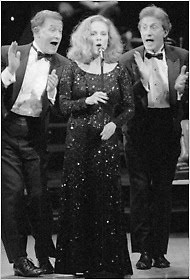
In Anyone Can Whistle, 1995

In talking with one of Madeline’s closest friends, I blurted out that I wished I’d known her and somehow been able to reassure her. In response, I got first a wondering look (as if to say, “Don’t you think I tried?”), and then the measured words, “Nobody could.”

Uneasy lies the head that wears the crown, and uneasy the beauty who stars on screen. Contemporary culture puts pressure on women to aspire to a certain standard of physical beauty, and Hollywood only intensifies that pressure on its actresses; I’m not sure we’ll ever figure out how to make life easier for them, though it surely helps that we’re more aware now of the challenges they face.

It would surely help, too, if we stopped comparing actresses
to water beds.


For most women, if you put on a few pounds, your self-esteem may suffer; for an actress, those same pounds can spell unemployment. And yet, to a degree, Madeline’s insecurities over her appearance underscore for me the ways in which her career — brilliant, enduring, unique — nevertheless touches on themes that are common to many American women today.

Madeline Kahn was a single woman working to support her family. She faced sexual harassment and was passed over for job opportunities, many of the jobs were tedious or beneath her abilities, and there were dry spells when she didn’t know where the next job was coming from.

And yet she kept at it, because she had to, and she gave it her best effort. I admire that in her — and in you, too.


Thursday, July 1, 2010

Madeline Kahn: Progress Report 8

As Musetta, with Alan Titus as Marcello.
Washington, DC, March 1970
Photo courtesy of Jeffrey Kahn. Used with permission.


For reasons of space, the editors of OPERA NEWS cut the anecdote with which I led off “Sweet Mystery,” my feature article on Madeline Kahn’s singing career in the July 2010 issue of that magazine. But it’s too good to pass by, so I’m sharing it now, while it’s timely.

In describing Madeline’s impact on popular culture — and, in particular, the impact of her brief rendition of Victor Herbert’s “Ah! Sweet Mystery of Life” in Mel Brooks’ Young Frankenstein — I got corroboration from a distinguished but somewhat surprising source, Bill Cosby.

“I remember performing during the time when [Young Frankenstein] came out,” Dr. Cosby said during our telephone conversation last year. “She hit that note. In those days, I was selling out 14 thousand-seaters. I’d be talking and doing my monologue, and people would be laughing. And I remember at least 15 different cities where some woman in the balcony during the laughter would hit that note. Women were copying that note.”

The girl can’t help it:
Singing Musetta’s waltz.
Photo courtesy of Jeffrey Kahn. Used with permission.

I expressed my surprise. In late 1974 and early 1975, there was no reason to make a mental link between Madeline Kahn and Bill Cosby: they wouldn’t work together for another two decades, and the black sheriff in Blazing Saddles was Cleavon Little, after all.

“I’m telling you the truth!” Dr. Cosby insisted, and as he explained, the link turns out to have been pleasure.

“That note became a classic. All around the United States, women knew, as far as I’m concerned, what that note was. Madeline Kahn hit the very positive — just the opposite of a Woody Allen orgasm.” Here, Dr. Cosby gave a wicked chuckle.

“People would be laughing at something I was saying, and my act was not sexually driven, but the woman would always be up in the balcony — it was always somebody up, it wasn’t anybody on the floor, I guess because the lights were on ’em. A woman! I guess — you have to take for granted it was a woman. You’d have to be to hit that note. When I remember that scene, in at least nine or whatever number I gave you, cities, they would hit that note.”

Co-stars at last: Kahn, Cosby, & Phylicia Rashad,
In the good doctor’s most recent sitcom.


Though some credit must go to the scriptwriters, Gene Wilder and Mel Brooks, Dr. Cosby believes that Madeline’s singing signaled a change in the way that women’s sexuality was depicted onscreen.*

“I want to go over this,” Dr. Cosby continued, “because psychologically, she did something with that note. When you think about directors, and cutting to fireplaces, cutting to — even in comedy, there have been some moments where they’ve taken landslides, snowslides, and things trees collapsing and you know, birds fly — flocks. But never that note that woman sang! It was just that note. And if you listen to it, it’s the build-up, and then she hit that note.

“Forget about it. Women all around these United States, women would do it in the audience, and the place would collapse.”

She wasn’t an opera star, but she played one
in Gene Wilder’s Sherlock Holmes’ Smarter Brother.

For the rest of what Dr. Cosby told me, you’ll have to wait a bit longer. For now, suffice to say that, from the start, Madeline’s musicality has seemed to me the foundation of her artistry, and learning more about it has been especially rewarding.

Thus far, I’ve been able to interview the baritone Alan Titus and the tenor William Lewis, two of her operatic co-stars; one of her voice teachers, Marlena Malas; her frequent coach and adviser, Michael Cohen; and her mother, Paula Kahn, herself an aspiring singer, who gave Madeline her first music lessons.**

Madeline’s family, friends, and colleagues also have helped me to understand the importance of music in her life, both professionally and privately. And I’ve discovered that musically-minded people — such as Bill Cosby himself — are among Madeline’s biggest admirers.

Though I have yet to find a publisher — and in truth we’re waiting for the industry to settle down a bit before shopping the biography around — I’m still at work. If you run out to your local newsstand and buy lots of copies of the July issue of OPERA NEWS (or, better yet, subscribe!), you’ll be helping to prove that, yes, there’s a market for this book.

In Vecchi’s Amfiparnaso at Hofstra University, 1964.
Photo courtesy of Jeffrey Kahn. Used with permission.


*NOTE: For those who don’t know the film, Madeline’s character, Elizabeth, bursts into “Ah! Sweet Mystery” when the Monster (Peter Boyle) ravishes her; Inga (Teri Garr) sings a reprise in the honeymoon scene at the end of the movie.

**Regrettably, Paula Kahn demurred when I asked if she’d give me a voice lesson. Now who do you suppose told her how badly I sing?


Wednesday, February 10, 2010

Crazy

Every now and then, a wonderful singer comes up with an interpretation so wrongheaded that you can only scratch your head and mutter, “What the hell?” Music lovers keep lists of such moments; for a long time, mine has been dominated by (but not limited to) Renata Scotto’s florid account of “Over the Rainbow,” on the occasion of Beverly Sills’ retirement. A lovely gesture to a colleague went horribly wrong, because the great Italian soprano couldn’t locate the correct style: simplicity.

Now another singer whom I admire, the French soprano Natalie Dessay, has topped the list. Her style isn’t bad, but the meaning of Bernstein’s “Glitter and Be Gay” eludes her entirely. What makes her rendition most troubling is that, on the evidence I’ve heard, other, younger French sopranos are now copying her travesty, in the not unreasonable belief that anything Dessay does must be right.

Dessay has been mangling this aria for a few years, but it’s only recently that I’ve identified the source of her misinterpretation, courtesy of the title of her latest album: Mad Scenes.


In its original context, “Glitter and Be Gay” finds the heroine of Candide in despair. She’s been raped, losing in the process not only her virginity but all her plans for a noble marriage back in Westphalia; she’s now a courtesan in Paris. But she takes comfort in the rewards of her new profession: jewels. Lots and lots of them. Which make her not only rich but even more beautiful. She stops crying and starts to laugh.

In an operetta that makes a frontal assault on many of the conventions of grand opera, “Glitter and Be Gay” shows us the soprano unhinged. Musically and dramatically, the song is a parody of the Jewel Song from Gounod’s Faust, and Cunegonde’s skipping, staccato “Ha-ha-ha” reflects Marguerite’s “Ah! Je ris de me voir si belle en ce miroir” (I laugh to see myself so beautiful in this mirror).

Dessay takes what ought to be a fou rire (giggle), maybe a little bit hysterical, and turns it into something madder. She doesn’t even articulate the “Ha-ha-ha” as laughter at all. She lands so wide of the mark that I couldn’t understand her intention, the first times I heard her sing the aria. And that’s unusual, given that she’s an exceptionally smart and communicative musician, whose English is fluent, and whose husband (the baritone Laurent Naouri) happens to speak nearly as well as I do.

What the hell? Then her new album came out: Mad Scenes. Oh. That explains everything. Almost.


So Dessay thinks Cunegonde is outright crazy — like Lucia di Lammermoor, Ophélie (in Ambroise Thomas’ Hamlet), and Bellini’s Elvira. Never mind that, if Bernstein wanted to write a parody of a mad scene, he’d have done so; instead, he wrote a parody of the Jewel Song. Even out of context, Dessay’s interpretation makes no sense — and she’s missing a terrific opportunity to poke fun at one of the hoariest clichés in French opera. (Even the Tintin comics mock the Jewel Song: it’s the only number in Bianca Castafiore’s repertoire.) I can’t imagine why that prospect didn’t appeal to Dessay.

Maybe it’s the fault of the record company. Wanting to spotlight a gallery of loony ladies in Dessay’s growing repertory, and to sync with her Metropolitan appearances as Lucia and Ophélie, they may have originated the “Mad Scenes” concept. But there weren’t enough arias to round out an album. “We need one more,” they said. “I don’t know any,” she replied. “What about ‘Glitter and Be Gay’?”

I’m guessing here. But to paraphrase another American musical comedy of the same generation, “So wrong! Farewell, auf Wiederseh’n, goodbye.”

I’ve heard a number of good singers do right by “Glitter and Be Gay,” starting with Wendy Chatman, who played Cunegonde in our college production of Candide, and continuing through Erie Mills, Harolyn Blackwell, and Diana Damrau; I’ve always regretted that Sills herself never sang the role. While June Anderson struck me as a tad Wagnerian, and Kristin Chenoweth a bit steely, they surely understand the song, too, and I’ve enjoyed their interpretations. To my pleasant surprise, the best of the lot turns out to be Madeline Kahn, who sang Cunegonde in a gala concert performance of Candide to mark Leonard Bernstein’s 50th birthday. Her friend Michael Cohen has told me that together they prepared “Glitter and Be Gay” even before she auditioned, so that it’s no wonder she’s note-perfect. (The rest of the cast, heard on a pirate recording, is less polished.) Madeline has all the notes and all the humor, with some touches I’ve never heard elsewhere. “Bracelets, lavaliers!” she growls with contempt, before imploring, “Can they dry my tears?” One of these days, I’m going to dub that recording and send a copy to Natalie Dessay.

Monday, January 25, 2010

Madeline Kahn: Progress Report 7

Madamina, il catologo è questo…

A new biography of Warren Beatty has gotten a lot of media attention lately, particularly for the author’s estimate of the number of women with whom the actor–director has slept. This titillating tally would humble any Don Giovanni, and tax the patience of any Leporello — but how can it possibly be relevant? I mean, does Beatty’s sexual track record in some way explain his approach to making movies? Does the biographer believe that love scenes onscreen are more credible, because of such exhaustive research off-camera? I’m not convinced.

Perhaps it’s a fundamental difference in philosophy, perhaps it’s just a question of taste, or a pragmatic response to a subject who did not have 12,775 sexual partners. But as I prepare the authorized biography of Madeline Kahn, I am infinitely more interested in her work than in her love life.

A different kind of performer

Naturally, I’ve spoken at length with John Hansbury, her husband; I’ve interviewed a few of her boyfriends, too, and read the love letters she kept in her desk. The things I’ve learned tell me much about her personality, but honestly, her musical training tells me more about her as an actress. And her parents’ sex lives — specifically the way her mother’s two divorces represented the loss of two fathers — probably tell me more about why she wanted to be an actress in the first place.

Though in saying this I may doom my commercial prospects, say it I must: this book won’t be very sexy.

Kiss and Don’t Tell:
Not a love scene — and yet significant.


Examining her work on its own terms will be challenge enough. “Who can say how she did what she did?” another delightful actress, Carol Kane, asked me, when this project was just taking shape — and she meant that as a warning, I think. I’ll be lucky enough to point out a few details that may help a reader appreciate Madeline’s work a little better.

For example, I can’t tell you why Madeline is more charming with a rubber duck on her head, in her cameo in the Sesame Street sing-a-thon “Put Down the Duckie” — but she is. And at least I can point out the duck.

In answer to the question posed by many readers of this blog, writing Madeline’s biography will take somewhat longer than expected. Pummeled by a weak economy and a pitiless technological revolution, the book business is bad. Though I hoped last January to know my publication date by now, I still don’t know even my publisher’s name.

The bright side is that I get the opportunity to spend more time talking with her family, friends, and colleagues, and a couple of recent interviews have yielded some great fun. What journalist hasn’t yearned for an interview subject to shout, “Provoke me!” — as Ed Asner did? And Eileen Brennan spoke for a lot of people I love when she exulted, “God, I love music! Even more than dogs! Even more than cats!

Zero Degrees of Separation: Brennan and Asner teamed up
in a short-lived sitcom, Off the Rack


And I take comfort in the knowledge that Madeline would prefer — if indeed any biography be written at all — that I avoid gossip. She valued her privacy, and she was shy among fans precisely because she worried that they expected her to be the bawdy character she played in Mel Brooks’ movies, a far cry from her reserved, well-mannered self. Peter Bogdanovich told me it was a struggle just to get her to say the word “tits” in Paper Moon (1973).

Somewhere, Madeline is smiling now with genteel but genuine satisfaction that I don’t know, and am unlikely to find out, who “Bop” was, for example, the author of so many torrid love letters signed only with that singular nickname. His letters don’t, in any case, tell me one damned thing about the work in which she took such justifiable pride.

The work is what lasts, and it’s what she wanted us to keep.

Tuesday, September 29, 2009

Madeline Kahn: Progress Report 6

Though this is not really a report on my progress in writing her authorized biography, I note that today marks Madeline Kahn’s 67th birthday. How young she would have been, if she were still among us! It’s a reminder that she managed to create an admirable body of work in a relatively short time, and to make a lasting impression on us.

Please join me in celebrating her memory today — perhaps in a chorus of “Ah! Sweet Mystery of Life.”
And a reminder: if you’d like to help in the fight against ovarian cancer — the disease that cut short the sweet mystery of Madeline’s life — you can make a donation to the Ovarian Cancer Research Fund. Thanks.